
Over winter break, in an effort to do some decluttering, I stumbled upon my old, black CD-ROM bookbinder. Pages and pages were filled with CDs containing the names of my childhood heroes: Putt Putt, Pajama Sam, Freddi Fish, and Spy Fox. These games, made by Humongous Entertainment, combined puzzles, animation, and educational content (though it never seemed like it) into a wonderful work of art. Through the games’ adventurous, yet challenging gameplay, I learned complex concepts such as telling time and physics. Instantly, I desired to see if the games still worked, seeing as they were at least 15 years old.
I sprinted to my mom’s computer (because CD slots on Macbooks are obsolete) and chose my first victim–Freddi Fish: The Case of the Stolen Conch Shell. To my disappointment, I was met with a popup explaining that the computer cannot play 16-bit games. However, the desire for nostalgia was too great to quit, so I picked up the next game–Freddi Fish: The Case of the Creature of Coral Cove, and to my surprise…the old rectangular starting screen popped up!

For as long as I can remember, CD games have always held a special place in my heart because they were the first type of video game format I was ever introduced to. CDs are unique because they capture a moment in time; there are no updates or game pack expansions. Because of this, CDs can preserve what was visually and aesthetically capable for the game at the time of its creation. I was hit in the face with this fact when, upon pressing “Play” for my Freddi Fish game, a popup asked if I was able to “connect to the internet with a modem” or, if not, directed me to register with a “mail-in card.” Without CDs, much is to be forgotten about the ways past games used to function as we take for granted the ease of access to video games that we have now.

Additionally, because CDs are physical objects which must be put into a computer to be played, it is incredibly important to protect their exteriors. Admittedly, discs scratch way too easily (especially in the hands of a clumsy five-year-old); however, those who value the games that these disks contain learn quickly to cherish them. Because of this, CDs become sacred objects to be protected. If we are to think of these discs as “holy objects,” then dusting them off and flipping through one’s CD collection can be regarded as a ritualistic experience (bet you didn’t think you’d be hit in the face with this deep metaphor today). Unlike modern downloadable games which cannot be easily broken, CD games hold higher stakes because of their fragility, making them more valuable.
Another upside to physical copies of video games is that they often foster a form of community between players. Although these educational adventure games were primarily single-player, I’d often loan my discs to friends who wished to play the game too. This sort of sharing is impossible to do with purchased downloadable games as the game is downloaded onto a single computer, unable to be transferred among devices that don’t belong to the user who bought the game.
Although we often see popular media adapted into video games, as with Lord of the Rings Online or Marvel’s Spiderman video game, these CD games experienced the opposite phenomenon. Because children grew obsessed with the video game’s characters, they also fell in love with their stories and lore. Logically, figurines and books were then created, such as Putt-Putt Lost in Time which took the CD characters and expanded on stories seen in the video games. As more and more fascination around these games grew, other unrelated companies wanted in on the action. Cereal companies, such as General Mills and Kellogg’s, began including CDs, including Humongous Entertainment games, inside of their boxes as an incentive to buy their cereal (I miss the days when cereal box prizes were actually this good).
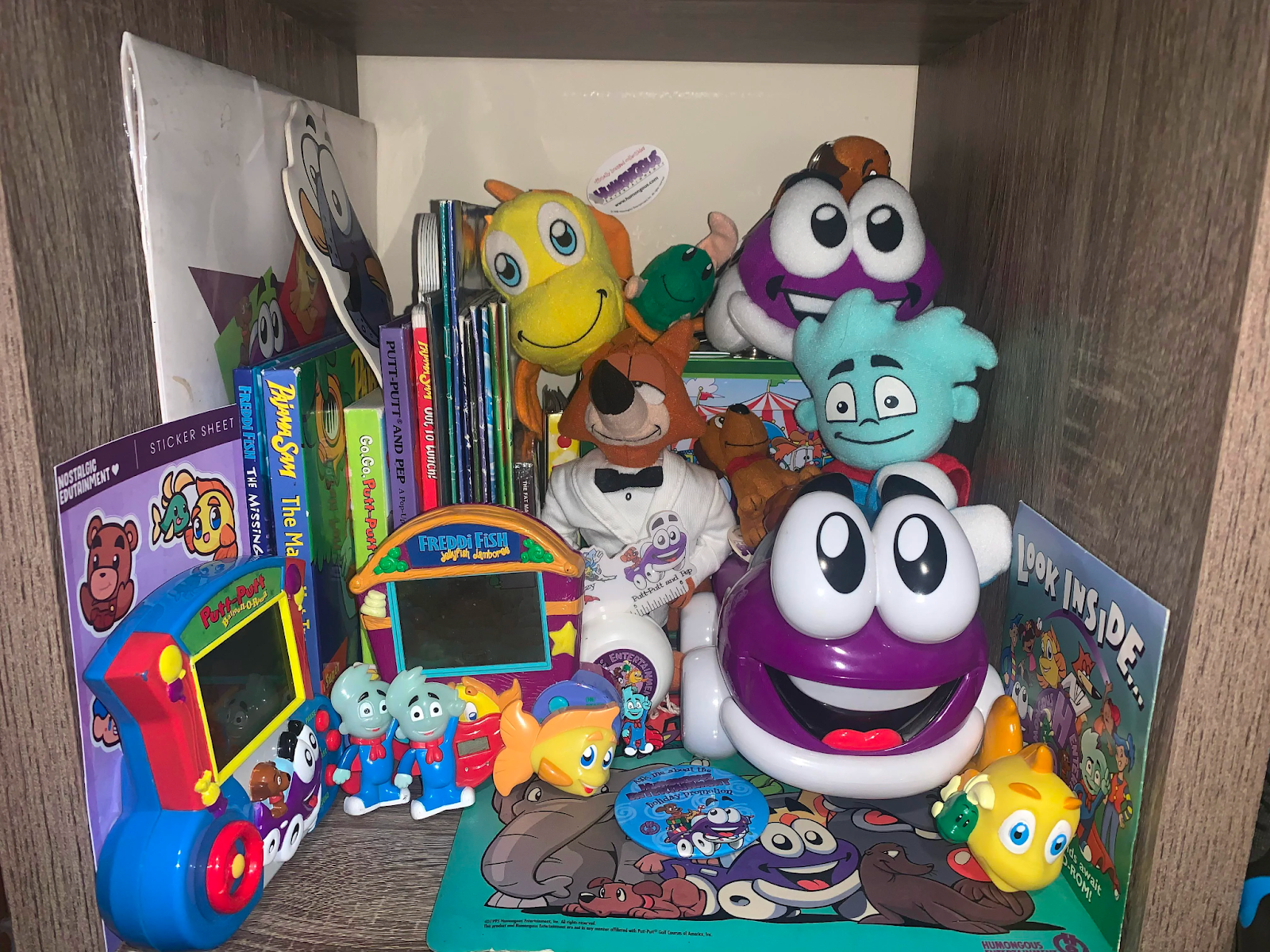
u/pezhead53 on Reddit
As I grew up and fell away from the game’s age range, so did technology, making CD games virtually unplayable nowadays (no pun intended). Although Humongous Entertainment has converted its games into versions that can now be bought digitally, the nostalgia these games emit is lessened. Seeing the juxtaposition of the pixelated graphics on my HD computer feels ingenuine and, to continue with my previous metaphor, sacrilegious.
Others, like myself, turn back to the discs (at least the ones that still work) rather than newer versions of the games for pure nostalgia alone. In fact, the other day, a TikTok by user Ricky Peacock shared a video of himself playing a Putt Putt game, emphasizing the fact that although he hadn’t played this game since he was a child, he still remembers trivial aspects of the game, such as the “wagon wheels” treats.
While there are many downsides to CDs, including their fragility, incompatibility with newer computers, and environmental impact, they still hold many redeemable qualities that shouldn’t be overlooked. While it may be true that I’m being blinded by the nostalgia of my childhood games, I believe CDs hold an inherent value when discussing the history and future of video games. Whether or not we see game developers shift towards offering their games in a disc format, I think it’s still comforting to know that my old playthroughs still exist somewhere on my treasured CDs, uncorrupted and archived in history, even if I can’t open them anymore. I just hope I managed to spell my name right on the save file!
– Marissa Tessier
 New Media: Storytelling in Literature, Films, and Games
You must be logged in to post a comment.